Categories
Music

Heil Herbert?

A mate of mine, Nottingham poet Neil Fulwood, got a few of us talking about Herbert Von Karajan, recently. With tongue firmly inserted in cheek, I referred to the late HVK as the ‘Nazi conductor.’ Not, as it quickly transpired, a particularly wise move as one devotee of the departed maestro quickly took up arms – figuratively, that is – in defence of his hero.

For the record, Von Karajan’s membership of the Nazi Party is generally accepted by most historians and musicologists to have been prompted by an amalgam of self-preservation, expediency and shameless opportunism, rather than any sort of ideological commitment. Certainly, his biographer Richard Osborne goes into fascinating detail about this period of the great maestro’s life and does not spare his subject. There is no one more authoritative than Osborne and he also tells of Von Karajan very courageously resigning his Party membership during the war, following his marriage to second wife Anita, who was of Jewish heritage (as an aside, Osborne’s book, at a gargantuan 900-odd pages, is simply fascinating and well worth the parting of a few of your readies).

So, with that potentially divisive issue behind us, our attention turned to HVK’s legacy. Positioned by Neil’s friend as that of, “… a great conductor whose musical legacy continues to inspire listeners the world over some 25 years after his death?”

Now I’m a man of peace and my ways are the ways of peace but somethings simply cannot be allowed to go unchallenged. My own take where HVK is concerned is a tad more qualified. Certainly, he had greatness within him and some of his contributions to recorded music are peerless. Both his Mahler 9ths are probably the best ever recorded by anyone, Strauss (another Nazi, by the way. JOKE!!!) never sounded better than via Herbert Von Karajan and his ’63 Beethoven set is, for my money, still the best recording of that over-recorded ubiquitous symphonic cycle ever committed to vinyl, tape or disc (I think Herbert recorded the complete cycle an astonishing five times, too).

He also deserves huge respect for his humility and good judgement where Mahler is concerned. Too many maestros assume they need to record the complete cycle when they just aren’t up to it. HVK, at least, eschewed such arrogance and the Mahler he did choose to tackle is amongst the very finest you will hear.

However, he suffered from Deutsche Grammophon’s (successful) efforts to market him as classical music’s first rock star. There are dozens of howlers forced out to make a buck and to hear him rushing an under-rehearsed, lead-footed and elephantine BPO through the Brandenburg Concerti is to know pain at its most real and acute.

I can live quite happily with Neil’s counter-take when he said, “I can happily write off the baroque stuff for the utter majesty of the Bruckner cycle, the ’63 Beethoven set (only Bernstein’s VPO cycle on DG really compares), the Strauss (his Vier Letzte Lieder with Janowitz is the finest I’ve heard), the Schumann (a composer HVK never got the due credit for his recordings of) … the list goes on. Sure, he was (and still is, in terms of reissues) DG’s licence to print money. But if some dodgy baroque recordings were the quick buck that got the magnificent symphony cycles recorded, then who’s counting?”

Whatever your take, there is no doubt that Von Karajan was responsible for some of the greatest interpretations of some of the greatest music ever written. So, with that said, here he is doing what he did best. And better than most. Enjoy.

http://www.youtube.com/watch?v=gnMAGwLBhpM

Categories
Culture Politics & Current Affairs

Darkness, Darkness

One of the more enjoyable aspects of the promo work for my book, earlier this year, was crossing paths with other writers whose work I admire. One such was John Harvey. Connoisseurs of British crime fiction will know Harvey well, of course. In a lengthy and impressive career, taking in poetry, broadcasting and much else, John is, perhaps, most celebrated for his creation Detective Charlie Resnick, the Nottingham-based copper,  who I can’t help thinking of as the English John Rebus.

I met John in May when he was speaking at Waterstone’s in Nottingham about his final Resnick novel, Darkness, Darkness. I’d held a signing there myself, a couple of weeks previously, and the Events Manager, knowing of my fandom, generously furnished me with some tickets for John’s event.  Mr. Harvey was a delight; witty, engaging and interesting. The event was pretty much sold out and he fielded a variety of questions from the punters before concluding with a long queue of eager readers clutching copies of Darkness, Darkness to be signed.

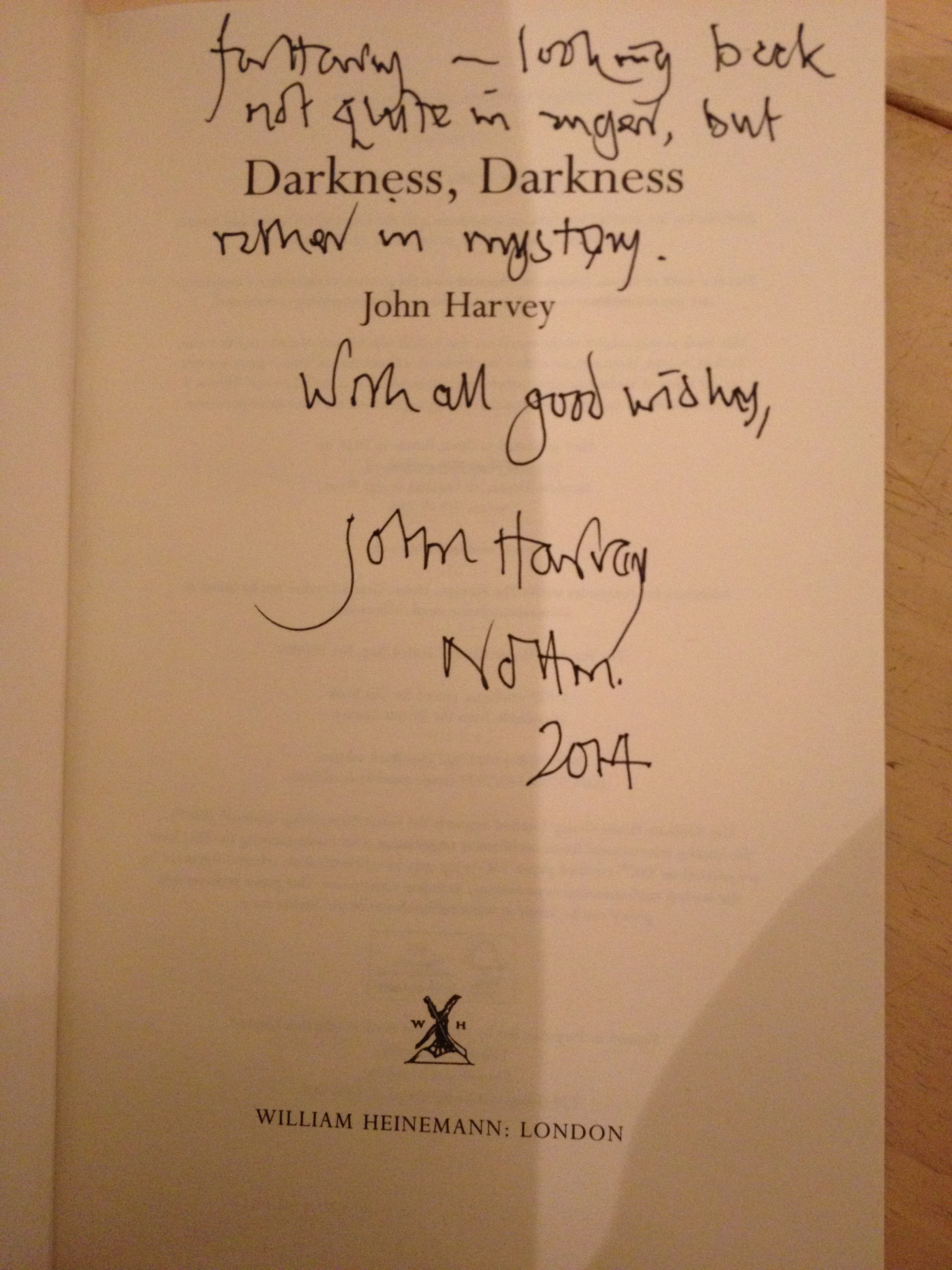
My publisher, Ross Bradshaw, the Managing Editor of Five Leaves Publications (and, more recently, the proprietor of the thoroughly excellent independent and radical Five Leaves Bookshop) has had a long professional relationship with John. When the two did a couple of additional promo events in the County, Ross very kindly had John sign me a shiny 1st edition of Resnick’s last case and his dedication very kindly references my own book; a great honour!

photo 2Of both personal and professional interest to me, the book is set during the miners’ strike, thirty years ago. The research is first-rate and John conveys an authentic and accurate flavour of the times. That said I was amused when Ross observed, “It’s not often I can say that I changed the course of literary history, but after I read a proof copy of John Harvey’s book I emailed him to say he had got a small but important detail of the aftermath of the 1984/85 Miners’ Strike in Nottinghamshire wrong and that he was not as conversant with the history of the local Robin Hood Railway Line as he could have been.

John received the comments on the last day it was possible to make changes, and, rather than responding “nobody likes a smart-arse, especially one who knows about trains”, he was able to get the publisher to make the changes. There we have it then, another novel saved from sin… or at least two small sentences amended that perhaps nobody else would have noticed, but still.”

It falls to me, then, to point out that both John and Ross still managed to miss a couple of things. Firstly, no Notts strikers marched back to work behind a brass band, with the Area firmly under the control of the scabs. And secondly, John cites the Area as having twenty-five pits; it actually had twenty-seven, at the time of the strike, with a further four workshops, making a total of thirty-one NUM Branches.

Neither of which detracts from what is a superb swansong for Charlie Resnick. Nuanced, rich and beautifully evocative, Darkness, Darkness is easily among the finest British crime novels published this year. Highly recommend.

Categories
Music

Listen Without Prejudice

As all fathers know, life affords few opportunities for deep satisfaction comparable to embarrassing one’s spawn. My love for My Chemical Romance’s The Black Parade being a particularly apposite case in point.

My sixteen year-old son, Satanicus Maximus, seems to find no contradiction in his recent worship of Black Veil Brides while pitilessly mocking his auld man for numbering The Black Parade among his all-time favourite albums.

Lurch, however, the Elder Spawn, at a Methuselahian twenty-four might, you’d think, be above such things. You’d be wrong, of course. He is still unable to restrain the sardonic curl of his upper lip when, on a visit to his old home stead of Patersongrad, he encounters my bad self happily spinning the offending disc.

Such genre snobbery is, of course, not new. I well recall my early 80s self keeping my passion for the work of Marc Almond firmly in the closet, lest my teenage metal creds be dashed forever. The admiration I had (still have) for the supremely talented Mr. Almond and Soft Cell being, to continue the rather tasteless metaphor, very much the love that dared not speak its name.

Be all that as it may, to return to the album in question, I will say this: it is a brave, imaginative and superbly-executed piece of work. The young band deciding, in the midle of the digital, disposable, attention-wrecking noughties, to release a concept album inspired by the great dinosaur rock acts of yore. The listener, therefore, will find a deliberate and brilliantly-wrought homage to Queen, Pink Floyd, ELO, Yes and others.

But it’s the powerful and distinctive voice of a young band at their peak that really scores. All the stereotyping and scorn the too-cool-for-school poseurs heaped upon the band’s collective head count for nought in the face of one of the very best albums of the last thirty years.

Gerard Way, far too frequently maligned as a self-indulgent, self-pitying emo poster boy, turns in a career-defining performance and the lyrics, all bitter asides, witty irony and biting cynicism; nestle snugly with moments of real heart, real beauty and a humanity that moves. Once described as The Dark Side of The Moon for the Tim Burton generation, The Black Parade is angry and celebratory, tender and bitter and very special indeed. Haters gonna hate, of course, but listen without prejudice, my friends. The Black Parade deserves nothing less. And so do you.

Categories
Music

Talent Borrows, Genius Steals

Talent borrows, genius steals.

Chatting to my good friend and fellow music journo, Ian Winwood, recently, the aforementioned phrase cropped up (widely attributed to long-gone-to-seed purveyor of embarrassing dross, Paul McCartney, if you’re interested).

If true, then Dutch symphonic gothsters Within Temptation are surely occupying the same cerebral plane as Stephen Hawking. Covered in Roses, from the current album Hydra, is little more than a cheeky reworking of a tune from their preceding album, entitled Faster. Which itself was a homage to Chris Isaak’s Wicked Game. Still with me? OK, but it gets better because said homage was actually inspired by HIM’s cover of Wicked Game. Confusing, I know, so allow me to sum up; what we have here is a band ripping-off their own song, which was a rip-off of a cover of someone else’s song. A rip-off of a rip-off of a cover. Cheeky, eh?

Personally, I don’t really care. Sharon den Adel has one of those voices that simply slays any objectivity to which I might aspire. Add in a canny and shamelessly commercial melody, a move-your-feet-now-muthafuckers rhythmic sensibility and a perfectly-judged tempo and your argument is invalid. As the kids say.

Enjoy.