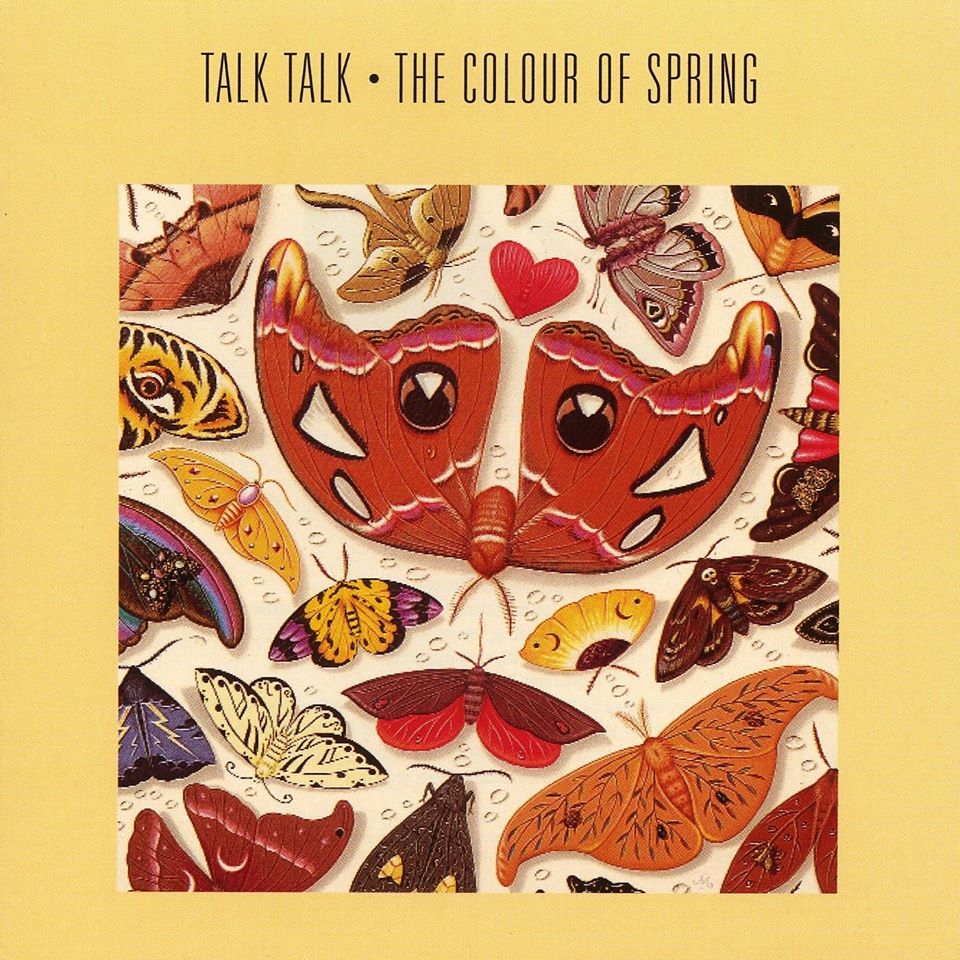
Japan and David Sylvian blew my mind. I used to listen to Obscure Alternatives, an album I disliked intensely, just so I could then play Gentlemen Take Polaroids and sit and wonder how the fuck they got from there to here. With just the stepping stone of Quiet Life between the two.
Bowie, at least in any serious way, was still a year or two down the line for me. Bryan Ferry, too. And Lou Reed and Eno as well. Maybe if I’d arrived at Japan and Sylvian chronologically they wouldn’t have seemed so other worldly. Who knows? Who cares…
But all my retrospection had been duly done by the time this came my way and still it hammered me. Like something from the great architect of the musical universe himself. It was something that shattered expectations, conventions and understandings.
And even the music itself, eerie & aching with all the yearning of one soul reaching out towards the rest of us, was still less than the sum of its parts. Not since Miles Davis did a musician understand the power of absence like Mark Hollis; the devastating impact of emptiness and the transforming force of the note unwritten; the note unplayed; the note unheard but always felt. But it had to be that way. Those big, haunting spaces made room for all the humanity he crammed in.
R.I.P. Mark Hollis. The world just got that little bit darker.
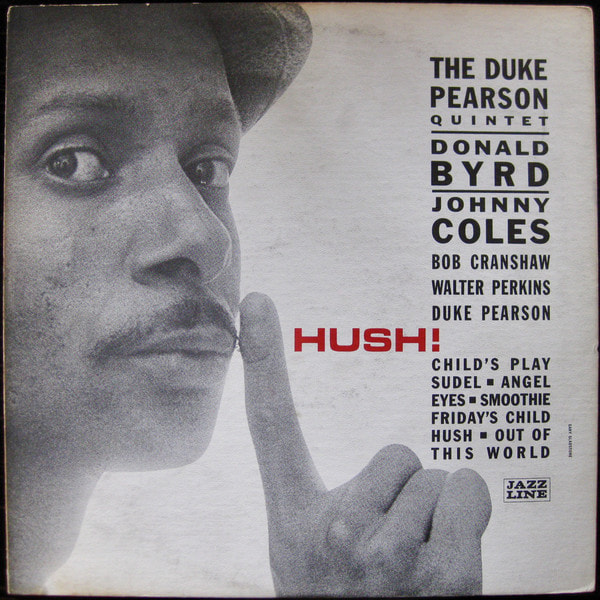
I bought this purely for Child’s Play. A spirited & infectious freewheeling work-out with Byrd and Coles; both of whom are clearly having a high old time.
The Duke himself, however, always passed me by. No doubting his lyrical feel & melodic sensibility (still less his skill as an arranger) but his improvs too often erred on the side of caution and in a time and place crammed with so much incendiary talent his minor status was pretty much assured.
This, though, is a delight and offers more than just the Byrd/Coles showcase. The short format suits Pearson perfectly and, the irritating fade-out on Angel Eyes aside, represents one of his most enjoyable sessions.
Conventional? Yes. Predictable, even. But a tight, compact session fizzing with energy and high on melody.
This is a brave, imaginative and superbly-executed piece of work. The young band deciding, in the middle of the digital, disposable, attention-wrecking noughties, to release a concept album inspired by the great dinosaur rock acts of yore. The listener, therefore, will find a deliberate and brilliantly-wrought homage to Queen, Pink Floyd, ELO, Yes and others.
Turbo-charged 70s stadium rock via post-911 armageddon emo and a nutty vaudeville workout sounds an unlikely, if not horrifying, amalgam. Yet its genius is not merely the audacious musical alchemy that the band deploy to stunning effect; it’s the humanity. And it rises, defiantly, from the cracks, between the charred and cancer-ravaged corpses that litter the album, like spring flowers defiantly in bloom; it’s the powerful and distinctive voice of a young band at their peak that really scores. All the Emo stereotyping and scorn heaped upon the band’s collective head count for nought in the face of one of the very best albums of the last thirty years.
Gerard Way, far too frequently maligned as a self-indulgent, self-pitying emo poster-boy, turns in a career-defining performance and the lyrics, all bitter asides, witty irony and biting cynicism, nestle snugly with moments of real heart, real beauty and an empathy that moves.
Once described as The Dark Side of The Moon for the Tim Burton generation, The Black Parade is angry and celebratory, tender and bitter and very special indeed. The listener will wade through death before the epiphany arrives; this album is life. And it is beauty unbound.
Haters gonna hate, of course, but listen without prejudice, my friends. The Black Parade deserves nothing less. And so do you.
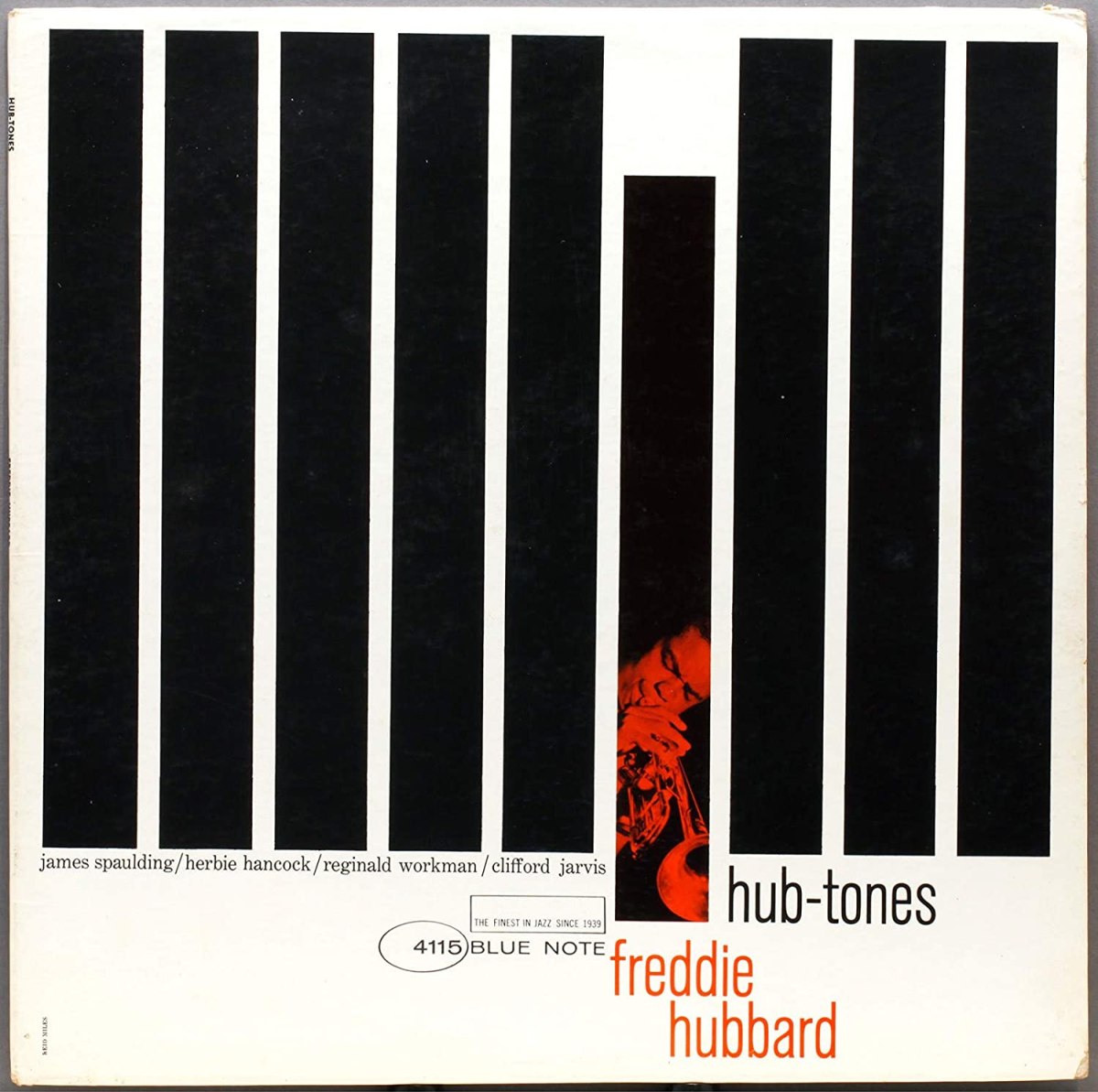
There has been some controversy regarding Blue Note‘s Rudy Van Gelder remasters but they work brilliantly for most listeners. The thing about the horns, and, of course, it’s purely subjective, is that these editions actually improve what many thought was a slight imbalance on the original recordings. Yes, we know Rudy liked to shove the brass right up in your face and, especially with a swaggering, incendiary player like Freddie, it’s great. But it often seemed as though the keys, in particular, and the bass, were low in the mix, rather than the horns being high, per se.
This 1962 set is a classic from Freddie, his sixth for Blue Note. Apart from the stellar contribution of Spaulding on alto, a nice alternative to tenor, and Herbie Hancock repaying Hubbard’s favour for Maiden Voyage, the confidence and mastery evident on Lament for Booker from the 24 yr old Hubbard is worth the price alone.
Miles Davis, for all his trailblazing vision and imagination, wasn’t even half the technical and physical horn player of Hubbard.
My career as a writer was preceded by a (more successful) career as a drinker and a (considerably less successful) stab at gambling. That lack of success increased exponentially when I combined the two. I’ve often wondered if there was a correlation. But I digress.
The point is, is that during those earlier incarnations I first encountered the work of Alan Sillitoe. I’d been hammered mercilessly in a brutal game of three-card brag, in a dive, somewhere on the outskirts of Nottingham. For those who don’t know the game, imagine, if you will, cards as close-quarter combat. This would make poker the graceful pinnacle of Shaolin Kung Fu and three card brag a pub brawl. With broken bottles and sawn-off pool cues. Especially if you play the insane can’t-see-a-blindman rule. But again, you’ll notice, I digress.
I’d suffered the bad beat from hell. Three aces running into a prile of threes. You’ll play your entire life and never even see one of those hands, never mind two, head-to-head, in the same game. Rigged? Aye, it crossed my mind.
Anyway, the aftermath of that sorry event saw me swaying under the impact of much whisky, in front of the piss-trough, ineffectually fumbling and scrabbling for my tackle. During my exertions I closed one eye and attempted to focus on the graffiti, virtually filling the entire wall above the urinal. “All I’m out for is a good time – all the rest is propaganda” was the message that caught my eye. It was signed A. Seaton. So now you know.
That was the start. Aged sixteen, in 1983, still smarting, five years down the line from our overnight flit from Alloa in Scotland to Nottinghamshire in England. Maybe it was the way Sillitoe made the Nottinghamshire towns important characters in their own right that chimed with my teenage angst; resentful, alienated and exiled, trying to make sense of this strange land in which I was a stranger. Sillitoe gave me a map; of the places, the people, their characters and the things that shaped them. It was the start of my peace with Nottinghamshire and, eventually, my love affair with that most contradictory of places. Literary giants sharing their history with working class heroes like the tiny band of striking Notts miners who braved scorn and brutality. Their opposite numbers who sold their children’s birthright for the hollow promises of Tory ministers and the class enemy’s shilling. The pitiless drug dealers and gunmen that saw ‘Scab City’ renamed ‘Shottingham.’ Aye, if it’s contrast, diversity and opposites you want, Nottingham has them in abundance.
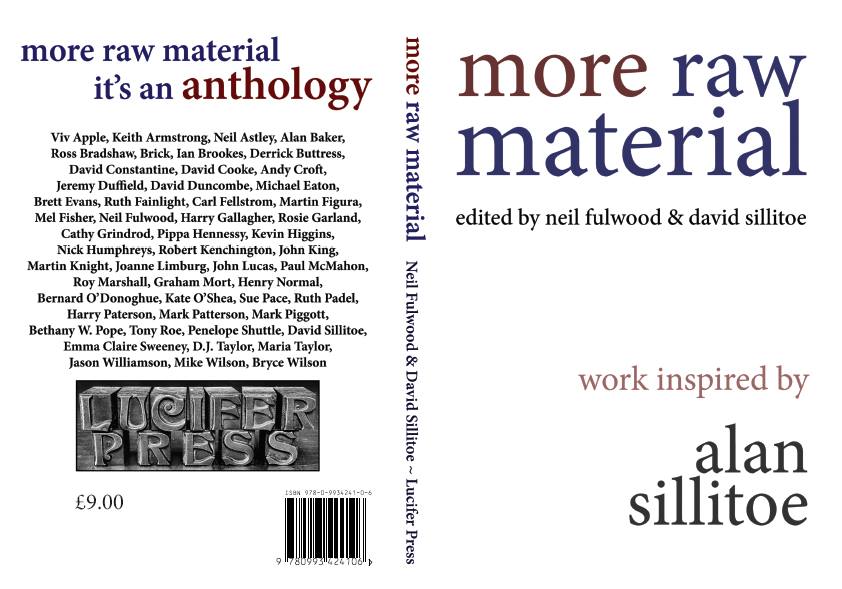
Yes, Alan and I go back a long way and so it was with great pride I accepted the invitation of co-editors Neil Fullwood and Alan’s son, David, to contribute to More Raw Material: Work Inspired By Alan Sillitoe.
Like most writers, I have The Stuff That I Do and…other stuff. Stuff that never sees the light of day. My usual gig of music journalism and political commentary seemed a poor fit for the book. And I’d always laboured under an inferiority complex anyway. Oh sure, non-fiction – which is what pays my bills – is noble and intellectual and valid. But as someone who constantly battles my inner reader to pipe down and let my outer writer get on with the job of keeping a roof over my family’s head, I’d always held the sneaking suspicion that fiction writers, novelists, poets (like Neil), people who told stories, were proper writers. So I had a go and sent it in. A short story. Not brilliant, but, I believe, one that does chime nicely with the spirits of More Raw Material and of David’s father. I’d never deny the influence of Alan and where better than in such a volume to let that influence take me where it may? So I did.
It’s a marvellous volume. Rich, diverse and eclectic. It contains photography, illustrations, poetry, travelogue, memoir, short fiction and much else. It’s a fitting tribute to a writer who knew no limits to his art and whose work covered all the above and more.
At the launch of the book, hosted by Five Leaves Bookshop, I was asked to read my contribution and it was an honour and a privilege. A full house enjoyed readings from talented poets Maria Taylor, Harry Gallagher and Henry Normal, non-fiction from Robert Kenchington and more. David concluded the evening in a moving tribute to his late father by reading a selection of his most powerful poems.
Published by Lucifer Press, More Raw Material is available from Five Leaves Bookshop, The Music Exchange, Rough Trade, the Tourism Centre, The Sparrow’s Nest in St Anns and The Bookcase in Lowdham and directly from co-editors Neil Fulwood and David Sillitoe. Tweet @lucifer_press
Stumbled over a couple of drafts of old reviews, earlier today, of Evil Scarecrow gigs from a few years back. I can’t recall where they originally appeared (or, frustratingly where and when the gigs took place) – Powerplay Magazine, perhaps, during my two-year stint with the mag – but on re-reading them I was immediately reminded of what a really great band they are.
They’ve had some well-deserved success, over recent years, including appearances at Bloodstock, the Metal Hammer awards and much else. All the while, bafflingly, remaining unsigned by a major rock or metal label. Such as they even exist these days.
News of the ‘Best Black Metal Parody Band from Nottingham, in The World, Ever’ appearing at this year’s Download Festival is both welcome and, hopefully, an opportunity for them to catch the eye of a decent label talent scout.
So no further excuse needed, then, to share their excellent new video and the very best wishes to the band and their lovely manager, Jen Hill, for Download ’15.
If you’re new to the band, here are those aforementioned reviews which will give you some idea of what you’re getting into…
As the Dies irae from Verdi’s Requiem filled the venue, Evil Scarecrow ascended the stage to a furious roar. Possibly Black Metal’s best kept secret, the parody band achieves the seemingly impossible task of combining a deep respect for extreme metal while mercilessly taking the piss.
Sixty Six Minutes Past Six, Vampire Trousers and Blacken The Everything contained enough blast beats, death growls and bowel-churning riffage to satisfy even the most po-faced of Norwegian Church burners, while simultaneously serving up a large side order of pure comedy genius.
Main man, Doctor Hell’s, famous 4 Note Solo triggered laughter all over the venue while Ashes induced moshing of such intensity that bodies crashed over the monitors and onto the stage, with wince-inducing regularity. Bassist Kraven Mordeth, skinsman Papa Bongo and keyboard player Princess Luxury played on, unconcernedly. Just another day at the altar. Lead guitarist, Brother Pain’s end of show crowd surf to the strains of the “…best Black Metal cover of The Final Countdown, in the world, ever” had to be seen to be believed.
Superb stuff and the best metal theatre since Alice Cooper exchanged guillotined babies for God and golf. Peerless.
And…
Pantomime metal mentalists, Evil Scarecrow, can seemingly do no wrong, currently. Their well-deserved and hard-earned rapidly ascending star shows no signs of dimming and their first visit to the MFN facilitated an enjoyable deflowering for many scarecrow virgins.
Architects, not so much of songs as comedy sketches of ironic invention, everything that is brilliant about this act was, tonight, on vibrant and multi-sensory display.
Morbid Witches kindly purchasing pints of mild, fashionistas sporting Vampyre Trousers and “…the most evil, most metal, most violent cover of a cartoon theme tune ever” (Thunder Cats, natch) were just some of the attractions on show at the Evil Scarecrow circus of comic madness.
Robotatron worked it’s failure-proofed, nutty magic, Dr Hell and Brother Pain each had their very own face-painted mini-me and a guest appearance by celebrity-groupie, Slagbot, ensured everything that was needed for the most fun to be had since, well, the last Evil Scarecrow party, was present and correct.
Dr Hell, even by his own particularly high standards, was on singular form and his doomed attempts to conjure the mass-sob fest that was Blacken The Everything were hilariously subverted by Brother Pain leading the rest of the band into an impromptu hoe-down.
His crazed rush around the venue, dispensing high fives along with the licks, kept the grin-quotient high while new drummer Ringmaster Monty Blitzfist’s manic and tireless theatrics, it has to be said, have raised the Scarecrow game to even greater heights.
The icy beauty of Princess Luxury thawed several times to reveal delighted grins while Kraven Morrdeth, all hearty Viking machismo, hammed it up marvellously. When a band is having as much fun as the crowd, magic happens. And it did.
Fast becoming an institution that is virtually criticism-resistant, Evil Scarecrow delivered yet another outstanding slice of tongue-in-cheek metal theatre that still, somehow, retains freshness, vitality and sincerity.
Six hundred and sixty six out of six hundred and sixty six.
Find out more at http://www.evilscarecrow.co.uk/ and https://www.facebook.com/Evil.Scarecrow?fref=ts
Mozart is reputed to have considered rhythm to be the most important element in music. One might wonder if the idiosyncratic, mercurial genius that was the late Glenn Gould would have agreed.
What prompted this train of thought was an early morning listen to Bach’s Italian Concerto. I’m a harpsichord snob but, on this occasion, I’d picked out a recording by Sokolov; purely for the rip-roaring final presto. I was taught that presto means to play as a quickly as possible. Far too many recordings of the the Italian Concerto fall apart when the musicians hit that all-important final movement. Instead reconfiguring it as a stately mid-tempo dance. This is to wreck some of JSB’s most exhilarating writing. The right hand should be a blur; hence Sokolov. But then I remembered I’d got Gould doing the thing. Now this is how it should be played. It’s executed at a, frankly, insane pace and is all the more grin inducingly-enjoyable as a result.
On this evidence, Gould must surely have considered tempo to be the most important element in music. While never, for even a moment, sacrificing melody or rhythm.
The presto kicks in here at 10:06. Put your seat belt on.
Despite my unshakeable life-long devotion to the cause of Alloa Athletic I’ve always had a large soft spot for Celtic. Definitely my second team (with Hibs being the third).
In all the years I’ve watched The Bhoys there hasn’t been a spell I’ve enjoyed as much as the seven seasons Henrik Larsson played for the club. 242 goals in all competitions means Larsson will forever enjoy legendary status at Paradise. Not for nothing is he revered among the Parkhead faithful as The King of Kings.
There are those who sneered at his achievements; a big footballing fish in the tiny bowl of the Scottish game, they said. How wrong such people were. Scoring against his old side in the Champions League for Barcelona, the class, dignity and character of the man was plainly in view when, clearly stricken, he refused to celebrate his goal, only to be met with a standing ovation from moved and appreciative sections of the Celtic fans.
On a three-month free loan to Man U in 2007, his goals against Aston Villa in a third-round FA Cup tie, plus Premiership and European strikes against Watford and Lile OSC, prompted a delighted Alex Ferguson to remark, “He’s been fantastic for us, his professionalism, his attitude, everything he’s done has been excellent. We would love him to stay but, obviously, he has made his promise to his family and Helsingborg and I think we should respect that – but I would have done anything to keep him.”
But it wan’t just the goals. Larsson was the complete footballer with one of the sweetest first-touches you’ll ever see. Even Huns boss, Dick Advocaat was forced to say, “Larsson is one of the best strikers in Europe, maybe the world. If you watch Batistuta, he is sometimes not seen for 90 minutes but then he scores two goals. Larsson has even more, because, besides being a good player and goalscorer, he has a tremendous work rate.”
So here, then, are all 242 goals the Swedish King scored in his seven-season stay at Celtic. Watch and enjoy. I doubt you’ll spend a more pleasurable fifteen-minutes all day.
I’d like to resist end-of-year best of lists but it’s a regular feature of the writing gig. I did, though, quite enjoy putting this one together for my publisher, Five Leaves, for their New Year newsletter.
They didn’t necessarily want the favourite five published in 2014 but the favourite five we writers read, or even re-read, during the year.
Here’s my unedited list, all of which are available from Five Leaves Bookshop.
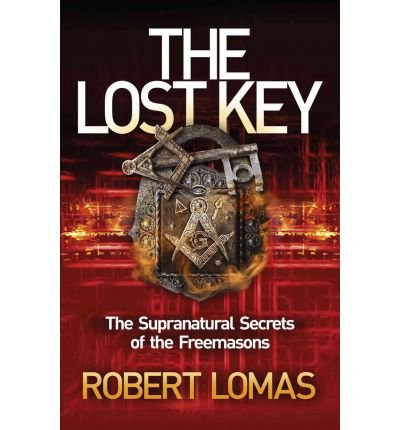
The Lost Key – Robert Lomas, Coronet
Thanks to Dan Brown, Freemasonry has rarely ‘enjoyed’ such publicity as that of recent years.
The ancient secret society (or the ‘society with secrets’, as it’s English ruling body, the United Grand Lodge of England would prefer you have it) has historically been the subject of fevered hysteria and paranoid conspiracy theories.
Here long-standing Freemason, scientist and author Robert Lomas lifts the lid on the secret rituals and their purpose as he sees it. In so doing he has constructed a truly fascinating narrative. The Lost Key is where science and mysticism meet, where religion and facts collide and where the reader is taken on an esoteric journey from the Big Bang, via the temples of ancient Egypt, medieval Scotland and Renaissance Europe to the present day.
If you thought Freemasonry was a bastion of establishment reaction and an excuse for monied gentry and corrupt coppers to indulge in silly pantomime with fine wine and good food at the end of the evening read this and be prepared to re-evaluate everything you thought you knew about ‘The Craft.’Fascinating, challenging and gripping.
Anarchists Against the Wall – Uri Gordon and Ohal Grietzer (editors) AK Press
And the best place for ’em some of my more tankie-inclined friends might suggest. But seriously… Anarchists Against the Wall are an anti-Zionist body of Israeli anarchists wedded fast to the Palestinian cause, Anarchists Against the Wall are a group of genuinely principled and courageous activists risking beatings, shootings and imprisonment on an almost daily basis operating, as they do, right at the sharp edge where the Zionist apartheid wall runs.
This small, independently-published edition collects a number of essays and observations by its members and offers an insight into the politics, activities and motivations of this heroic band of men and women.
Inspiring, uplifting and highly recommended.
Darkness, Darkness – John Harvey, William Heinemann
Former DI Charlie Resnick’s final case. The Nottingham-based copper, now retired and working as a civilian support officer, takes on the case of a woman who disappeared during the miners’ strike of 1984/5.
The strike provides a strong backdrop to a typically adroitly-spun yarn by the supremely talented Harvey. Set, obviously, in Nottinghamshire where the working majority wrecked the strike and ensured Thatcher’s victory over the Tories’ traditional class enemy, Harvey skilfully treads a fine line between the two sides as does his fictional hero Resnick.
The Resnick series deserves to be ranked alongside Rankin’s Rebus books and here Harvey weaves a poignant, elegiac narrative which is no less than he and Resnick deserve.
As swan-songs go this takes some beating. Beautiful, aching and deeply satisfying.
Intifada: The Long Day of Rage – David Pratt, Sunday Herald Books
Sunday Herald journalist, David Pratt, has produced here nothing less than a masterpiece of observational journalism.
Based in Israel/Palestine at the start of the first Intifada, and for the succeeding eight years, he records his experiences, observations and thoughts in compelling style.
While there is a refreshingly honest admission of sympathy for the Palestinian cause Pratt is too good a journalist to allow his work to become mired by bias. While the man’s empathy and compassion shines through his professional objectivity and dispassionate eye remain intact.
No one can fail to be deeply moved by this book.
The Enemy Within: The Secret War Against the Miners – 30th Anniversary Edition – Seumas Milne, Verso Books
The sub-title is a little confusing. It’s actually twenty-years since this book first appeared. The ‘30th anniversary’ refers to the three decades since the strike started.
With a wealth of new material and an extended introductory essay Milne’s classic account of state abuse and the dirty tricks deployed against former miners’ leader Arthur Scargill and the National Union of Mineworkers is as rage-inducing now as it ever was.
From a technical point of view this is truly superb investigative journalism. While Milne is far and away the best journalist currently writing for an English daily this must have taxed even him. A complex and bewildering saga is nevertheless rendered easily readable and the reader will be shocked, appalled and angered at the disgusting campaign of frame-ups, lies and corruption orchestrated by the three-headed monster of security services, press and government. Read it now.
I’m sure you – like me – were appalled on reading whisky ‘expert’ Jim Murphy’s verdict that some upstart Japanese single malt is now, officially, the world’s finest single malt whisky. The idea that such a thing could ever originate from outwith the shores of Scotland is, like time-travel and invisibility cloaks, scientifically impossible.
Possibly even more appalling was the degree of presumption displayed by the Japanese distillers, Yamazaki, in labelling their potion ‘whisky.’ As all right-thinking people know, if it isn’t distilled among the bonny banks and braes of God’s Own Country then it’s bloody well ‘whiskey’ thank you very much. And I don’t give a tinker’s cuss what Wikipedia says to the contrary.
Apart from anything else, how can you take seriously something purporting to be single malt yet calling itself Yamazaki? It sounds like it should come with a 500cc engine and handlebars.
Sadly, while discussing with friends on Facebook this ridiculous and nonsensical development, it became apparent that genuine appreciation of the sacred uisge beatha is hampered by reverse snobbery, unsophisticated palettes and unforgivable ignorance. Here then, is a simply entry-level guide to the noble art of whisky and the etiquette required for its correct consumption and, thus, enjoyment.
1. Scotland has four whisky regions (five, really, to true connoisseurs). Each with its own distinctive and highly individual character. They are the Islands; comprising Islay and Skye (although Islay should be considered the fifth region in its own right; such is the glory and towering majesty of its offerings), Highland, Speyside and Lowland.
2. Broadly speaking, whiskys from each region, while varying greatly from each other, will share strong core characteristics. Thus we can say Island malts are maritime and peaty. Highlands are smooth and floral, Speysides are sweet and delicate and Lowlands are light and fresh.
3. Of course that’s the general consensus. In reality, Islay single malts are the finest drinks ever created in the history of humanity. Laphroaig is the most complex and richly-favoured of them all. It is the undisputed King of single malts. Any who hold otherwise will be people of flexible morality, dubious virtue and questionable integrity. Ignore them.
4. Similarly, while Speyside produces the inarguably impressive The Glenlivet (it should always have ‘The’ to give it both its correct appellation and the respect it deserves) its produce tends toward the bland and sickly. The wearily ubiquitous Glenmorangie, for example, is commercialised nonsense. Adequate for grandmothers and the English but unfit to be taken in the company of men.
5. Ice in single malt whisky is not a matter of personal taste. It is wrong. Always. Its extreme temperature wrecks the balance of the whisky and chemically alters its taste. It numbs the palette, too, leading to an inability to actually taste, in all its complex magnificence, that which the Great Architect has seen fit to gift us. Single malt whisky should always be kept and taken at room temperature. Don’t be a peasant. Leave the ice in the freezer.
6. Water. Nowhere is there greater ignorance and reverse snobbery than on the question of water with one’s whisky. In many cases water can actually unlock the bouquet and release hitherto unknown wonders. As a very crude general rule, the higher ABV% of the whisky should dictate the ratio of water to whisky. I once had a superb Cadenhead’s bottling of a 12 year old Bowmore that clocked in at an eye-watering 74% ABV. Drinking it without water would have been utterly stupid and entirely pointless. Such high alcohol content serves only to numb and freeze the taste buds and palette and all that you will taste or smell will be the alcohol. A note of caution: water taken with single malt whisky should be of the lowest possible mineral content. Water with a high mineral content will act in much the same way as ice; it will ruin the balance and, again, chemically alter the whisky’s taste.
7. Our Celtic brothers and sisters from the Emerald Isle try their best, bless ’em, but that non-peaty, triple-distilled-to-within-an-inch-of-its-life juice they peddle is but a sorry apology for the mighty kings and queens of Alba. If you must drink whiskey then their blends are actually better. Jameson’s being particularly fine.
8. Another fallacy; the older a whisky is does not automatically mean it will be better. Some single malts mature very early. The Bowmore Legend, for example, carrying no age statement but widely understood to be only eight-years old, is a particularly apposite case here. The same point in reverse, I once had a 31 year-old Black Bowmore. It was, literally, black. As a result of stewing in oloroso sherry casks for three decades. I bought it for £175.00 and sold it a year or two later for £1050.00. It currently retails for circa £7,500.00 per bottle (yes, you read that correctly). Its rarity value is what commands such a price tag; not the quality of the whisky. Those who’ve tasted it tell me it’s virtually undrinkable.
9. There is such a thing as truly bad whisky. But remember; no whisky is even worse. Always.
10. Finally, few have so adequately captured the compelling power and eternal mystery of single malt whisky as the late great Campbell Armstrong. He deserves the last word here.
“The perfume, distilled perfection, bottled wonderment, magnetised him. He’d never seen liquid so golden and pure as that distilled from the cold clear waters of Speyside by Alchemists. Grapes made plump by the sun only gave you wine and what was that but a polite lubricant during a meal? A fine malt was something else. A triumph of nature; its drinkers were disciples, druids. Even the bloody names on the bottles were mystical incantations. Tamdhu. Tullibardine. Lagavulin. Strong Scots names that made Chateau This and Cabernet That decidedly unimpressive; effete little drinks for dilettantes.”




 Harry Paterson