Categories
Culture Music

The Magic Flute: Opera North

Nottingham Theatre Royal
There’s a school of thought that a decent Die Zauberflöte stands or falls on the strength (or lack thereof) of Papageno. Personally, I’ve always found the character capable of being immensely irritating and the mystifying preference of some to ham it up only intensifies my annoyance. Tonight’s culprit – Irish tenor, Gavin Ring – costumed as a bizarre combo of an extra from Mrs. Brown’s Boys and Vivien from The Young Ones, should’ve seen me bolting for the bar well before the end of Act 1. That I stayed was a testament to the overall excellence of one of the best Opera North productions I’ve ever seen. And, to be entirely fair, to Mr. Ring who, despite the shudderingly ridiculous costume, delivered a performance of warmth and charm.

Capture

The Magic Flute is one of only two operas, three at a push, that I can stand in English translation and while Schikeneder might have wept oceans at the liberties taken with his libretto, Opera North delivered a superb production.

The sets, FX and costumes held up well against anything on offer at Covent Garden this season and the pacing was perfect.

Musically, the company rarely fails to deliver, and this production was no exception. Many highlights but, for me, the Three Ladies were outstanding.

The poniards, hoodwinks, cabletows and regular steps (and a ‘Festive Board’ I kid you not!) provided nudge-nudge-wink-wink enjoyment for any Freemasons in the audience but the honours went to soprano Samantha Hays. Her Queen of The Night – unusually, all intense vulnerability and stricken pathos – was mesmerising and commanded the audience’s sympathy. Well, mine at least…

Categories
Culture

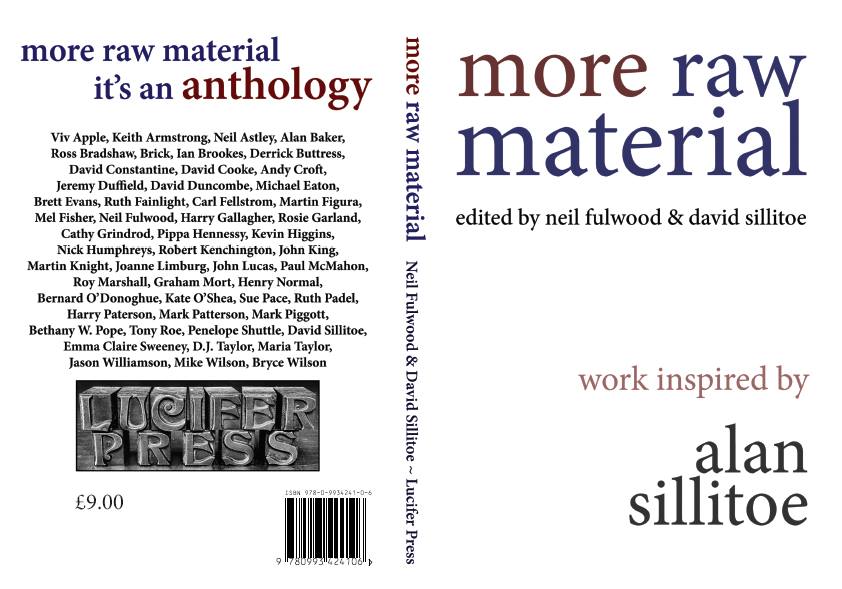
More Raw Material

MRMMy career as a writer was preceded by a (more successful) career as a drinker and a (considerably less successful) stab at gambling. That lack of success increased exponentially when I combined the two. I’ve often wondered if there was a correlation. But I digress.

The point is, is that during those earlier incarnations I first encountered the work of Alan Sillitoe. I’d been hammered mercilessly in a brutal game of three-card brag, in a dive, somewhere on the outskirts of Nottingham. For those who don’t know the game, imagine, if you will, cards as close-quarter combat. This would make poker the graceful pinnacle of Shaolin Kung Fu and three card brag a pub brawl. With broken bottles and sawn-off pool cues. Especially if you play the insane can’t-see-a-blindman rule. But again, you’ll notice, I digress.

I’d suffered the bad beat from hell. Three aces running into a prile of threes. You’ll play your entire life and never even see one of those hands, never mind two, head-to-head, in the same game. Rigged? Aye, it crossed my mind.

Anyway, the aftermath of that sorry event saw me swaying under the impact of much whisky, in front of the piss-trough, ineffectually fumbling and scrabbling for my tackle. During my exertions I closed one eye and attempted to focus on the graffiti, virtually filling the entire wall above the urinal. “All I’m out for is a good time – all the rest is propaganda” was the message that caught my eye. It was signed A. Seaton. So now you know.

That was the start. Aged sixteen, in 1983, still smarting, five years down the line from our overnight flit from Alloa in Scotland to Nottinghamshire in England. Maybe it was the way Sillitoe made the Nottinghamshire towns important characters in their own right that chimed with my teenage angst; resentful, alienated and exiled, trying to make sense of this strange land in which I was a stranger. Sillitoe gave me a map; of the places, the people, their characters and the things that shaped them. It was the start of my peace with Nottinghamshire and, eventually, my love affair with that most contradictory of places. Literary giants sharing their history with working class heroes like the tiny band of striking Notts miners who braved scorn and brutality. Their opposite numbers who sold their children’s birthright for the hollow promises of Tory ministers and the class enemy’s shilling. The pitiless drug dealers and gunmen that saw ‘Scab City’ renamed ‘Shottingham.’ Aye, if it’s contrast, diversity and opposites you want, Nottingham has them in abundance.

Yes, Alan and I go back a long way and so it was with great pride I accepted the invitation of co-editors Neil Fullwood and Alan’s son, David, to contribute to More Raw Material: Work Inspired By Alan Sillitoe.

Like most writers, I have The Stuff That I Do and…other stuff. Stuff that never sees the light of day. My usual gig of music journalism and political commentary seemed a poor fit for the book. And I’d always laboured under an inferiority complex anyway. Oh sure, non-fiction – which is what pays my bills – is noble and intellectual and valid. But as someone who constantly battles my inner reader to pipe down and let my outer writer get on with the job of keeping a roof over my family’s head, I’d always held the sneaking suspicion that fiction writers, novelists, poets (like Neil), people who told stories, were proper writers. So I had a go and sent it in. A short story. Not brilliant, but, I believe, one that does chime nicely with the spirits of More Raw Material and of David’s father. I’d never deny the influence of Alan and where better than in such a volume to let that influence take me where it may? So I did.

It’s a marvellous volume. Rich, diverse and eclectic. It contains photography, illustrations, poetry, travelogue, memoir, short fiction and much else. It’s a fitting tribute to a writer who knew no limits to his art and whose work covered all the above and more.

At the launch of the book, hosted by Five Leaves Bookshop, I was asked to read my contribution and it was an honour and a privilege. A full house enjoyed readings from talented poets Maria Taylor, Harry Gallagher and Henry Normal, non-fiction from Robert Kenchington and more. David concluded the evening in a moving tribute to his late father by reading a selection of his most powerful poems.

Published by Lucifer Press, More Raw Material is available from Five Leaves Bookshop, The Music Exchange, Rough Trade, the Tourism Centre, The Sparrow’s Nest in St Anns and The Bookcase in Lowdham and directly from co-editors Neil Fulwood and David Sillitoe. Tweet @lucifer_press

Categories
Culture Politics & Current Affairs

Favourite Books of 2014

I’d like to resist end-of-year best of lists but it’s a regular feature of the writing gig. I did, though, quite enjoy putting this one together for my publisher, Five Leaves, for their New Year newsletter.

They didn’t necessarily want the favourite five published in 2014 but the favourite five we writers read, or even re-read, during the year.

Here’s my unedited list, all of which are available from Five Leaves Bookshop.

The Lost Key – Robert Lomas, Coronet

Thanks to Dan Brown, Freemasonry has rarely ‘enjoyed’ such publicity as that of recent LOST keyyears.

The ancient secret society (or the ‘society with secrets’, as it’s English ruling body, the United Grand Lodge of England would prefer you have it) has historically been the subject of fevered hysteria and paranoid conspiracy theories.

Here long-standing Freemason, scientist and author Robert Lomas lifts the lid on the secret rituals and their purpose as he sees it. In so doing he has constructed a truly fascinating narrative. The Lost Key is where science and mysticism meet, where religion and facts collide and where the reader is taken on an esoteric journey from the Big Bang, via the temples of ancient Egypt, medieval Scotland and Renaissance Europe to the present day.

If you thought Freemasonry was a bastion of establishment reaction and an excuse for monied gentry and corrupt coppers to indulge in silly pantomime with fine wine and good food at the end of the evening read this and be prepared to re-evaluate everything you thought you knew about ‘The Craft.’Fascinating, challenging and gripping.

Anarchists Against the Wall – Uri Gordon and Ohal Grietzer (editors) AK Press

AATWAnd the best place for ’em some of my more tankie-inclined friends might suggest. But seriously… Anarchists Against the Wall are an anti-Zionist body of Israeli anarchists wedded fast to the Palestinian cause, Anarchists Against the Wall are a group of genuinely principled and courageous activists risking beatings, shootings and imprisonment on an almost daily basis operating, as they do, right at the sharp edge where the Zionist apartheid wall runs.

This small, independently-published edition collects a number of essays and observations by its members and offers an insight into the politics, activities and motivations of this heroic band of men and women.

Inspiring, uplifting and highly recommended.

Darkness, Darkness – John Harvey, William Heinemann

Former DI Charlie Resnick’s final case. The Nottingham-based copper, now retired andJH working as a civilian support officer, takes on the case of a woman who disappeared during the miners’ strike of 1984/5.

The strike provides a strong backdrop to a typically adroitly-spun yarn by the supremely talented Harvey. Set, obviously, in Nottinghamshire where the working majority wrecked the strike and ensured Thatcher’s victory over the Tories’ traditional class enemy, Harvey skilfully treads a fine line between the two sides as does his fictional hero Resnick.

The Resnick series deserves to be ranked alongside Rankin’s Rebus books and here Harvey weaves a poignant, elegiac narrative which is no less than he and Resnick deserve.
As swan-songs go this takes some beating. Beautiful, aching and deeply satisfying.

Intifada: The Long Day of Rage – David Pratt, Sunday Herald Books

IntifadaSunday Herald journalist, David Pratt, has produced here nothing less than a masterpiece of observational journalism.
Based in Israel/Palestine at the start of the first Intifada, and for the succeeding eight years, he records his experiences, observations and thoughts in compelling style.

While there is a refreshingly honest admission of sympathy for the Palestinian cause Pratt is too good a journalist to allow his work to become mired by bias. While the man’s empathy and compassion shines through his professional objectivity and dispassionate eye remain intact.

No one can fail to be deeply moved by this book.

The Enemy Within: The Secret War Against the Miners – 30th Anniversary EditionSeumas Milne, Verso Books

The sub-title is a little confusing. It’s actually twenty-years since this book first appeared.EW The ‘30th anniversary’ refers to the three decades since the strike started.

With a wealth of new material and an extended introductory essay Milne’s classic account of state abuse and the dirty tricks deployed against former miners’ leader Arthur Scargill and the National Union of Mineworkers is as rage-inducing now as it ever was.

From a technical point of view this is truly superb investigative journalism. While Milne is far and away the best journalist currently writing for an English daily this must have taxed even him. A complex and bewildering saga is nevertheless rendered easily readable and the reader will be shocked, appalled and angered at the disgusting campaign of frame-ups, lies and corruption orchestrated by the three-headed monster of security services, press and government. Read it now.

Categories
Culture Life

The Art and Science of Single Malt Whisky

pdx_whisky_4-06-12
I’m sure you – like me – were appalled on reading whisky ‘expert’ Jim Murphy’s verdict that some upstart Japanese single malt is now, officially, the world’s finest single malt whisky. The idea that such a thing could ever originate from outwith the shores of Scotland is, like time-travel and invisibility cloaks, scientifically impossible.

Possibly even more appalling was the degree of presumption displayed by the Japanese distillers, Yamazaki, in labelling their potion ‘whisky.’ As all right-thinking people know, if it isn’t distilled among the bonny banks and braes of God’s Own Country then it’s bloody well ‘whiskey’ thank you very much. And I don’t give a tinker’s cuss what Wikipedia says to the contrary.

Apart from anything else, how can you take seriously something purporting to be single malt yet calling itself Yamazaki? It sounds like it should come with a 500cc engine and handlebars.

Sadly, while discussing with friends on Facebook this ridiculous and nonsensical development, it became apparent that genuine appreciation of the sacred uisge beatha is hampered by reverse snobbery, unsophisticated palettes and unforgivable ignorance. Here then, is a simply entry-level guide to the noble art of whisky and the etiquette required for its correct consumption and, thus, enjoyment.

 1. Scotland has four whisky regions (five, really, to true connoisseurs). Each with its own distinctive and highly individual character. They are the Islands; comprising Islay and Skye (although Islay should be considered the fifth region in its own right; such is the glory and towering majesty of its offerings), Highland, Speyside and Lowland.

2. Broadly speaking, whiskys from each region, while varying greatly from each other, will share strong core characteristics. Thus we can say Island malts are maritime and peaty. Highlands are smooth and floral, Speysides are sweet and delicate and Lowlands are light and fresh.

3. Of course that’s the general consensus. In reality, Islay single malts are the finest drinks ever created in the history of humanity. Laphroaig is the most complex and richly-favoured of them all. It is the undisputed King of single malts. Any who hold otherwise will be people of flexible morality, dubious virtue and questionable integrity. Ignore them.

4. Similarly, while Speyside produces the inarguably impressive The Glenlivet (it should always have ‘The’ to give it both its correct appellation and the respect it deserves) its produce tends toward the bland and sickly. The wearily ubiquitous Glenmorangie, for example, is commercialised nonsense. Adequate for grandmothers and the English but unfit to be taken in the company of men.

5. Ice in single malt whisky is not a matter of personal taste. It is wrong. Always. Its extreme temperature wrecks the balance of the whisky and chemically alters its taste. It numbs the palette, too, leading to an inability to actually taste, in all its complex magnificence, that which the Great Architect has seen fit to gift us. Single malt whisky should always be kept and taken at room temperature. Don’t be a peasant. Leave the ice in the freezer.

6. Water. Nowhere is there greater ignorance and reverse snobbery than on the question of water with one’s whisky. In many cases water can actually unlock the bouquet and release hitherto unknown wonders. As a very crude general rule, the higher ABV% of the whisky should dictate the ratio of water to whisky. I once had a superb Cadenhead’s bottling of a 12 year old Bowmore that clocked in at an eye-watering 74% ABV. Drinking it without water would have been utterly stupid and entirely pointless. Such high alcohol content serves only to numb and freeze the taste buds and palette and all that you will taste or smell will be the alcohol. A note of caution: water taken with single malt whisky should be of the lowest possible mineral content. Water with a high mineral content will act in much the same way as ice; it will ruin the balance and, again, chemically alter the whisky’s taste.

7. Our Celtic brothers and sisters from the Emerald Isle try their best, bless ’em, but that non-peaty, triple-distilled-to-within-an-inch-of-its-life juice they peddle is but a sorry apology for the mighty kings and queens of Alba. If you must drink whiskey then their blends are actually better. Jameson’s being particularly fine.

8. Another fallacy; the older a whisky is does not automatically mean it will be better. Some single malts mature very early. The Bowmore Legend, for example, carrying no age statement but widely understood to be only eight-years old, is a particularly apposite case here. The same point in reverse, I once had a 31 year-old Black Bowmore. It was, literally, black. As a result of stewing in oloroso sherry casks for three decades. I bought it for £175.00 and sold it a year or two later for £1050.00. It currently retails for circa £7,500.00 per bottle (yes, you read that correctly). Its rarity value is what commands such a price tag; not the quality of the whisky. Those who’ve tasted it tell me it’s virtually undrinkable.

9. There is such a thing as truly bad whisky. But remember; no whisky is even worse. Always.

10. Finally, few have so adequately captured the compelling power and eternal mystery of single malt whisky as the late great Campbell Armstrong. He deserves the last word here.

“The perfume, distilled perfection, bottled wonderment, magnetised him. He’d never seen liquid so golden and pure as that distilled from the cold clear waters of Speyside by Alchemists. Grapes made plump by the sun only gave you wine and what was that but a polite lubricant during a meal? A fine malt was something else. A triumph of nature; its drinkers were disciples, druids. Even the bloody names on the bottles were mystical incantations. Tamdhu. Tullibardine. Lagavulin. Strong Scots names that made Chateau This and Cabernet That decidedly unimpressive; effete little drinks for dilettantes.”

Categories
Culture Politics & Current Affairs

Darkness, Darkness

One of the more enjoyable aspects of the promo work for my book, earlier this year, was crossing paths with other writers whose work I admire. One such was John Harvey. Connoisseurs of British crime fiction will know Harvey well, of course. In a lengthy and impressive career, taking in poetry, broadcasting and much else, John is, perhaps, most celebrated for his creation Detective Charlie Resnick, the Nottingham-based copper,  who I can’t help thinking of as the English John Rebus.

I met John in May when he was speaking at Waterstone’s in Nottingham about his final Resnick novel, Darkness, Darkness. I’d held a signing there myself, a couple of weeks previously, and the Events Manager, knowing of my fandom, generously furnished me with some tickets for John’s event.  Mr. Harvey was a delight; witty, engaging and interesting. The event was pretty much sold out and he fielded a variety of questions from the punters before concluding with a long queue of eager readers clutching copies of Darkness, Darkness to be signed.

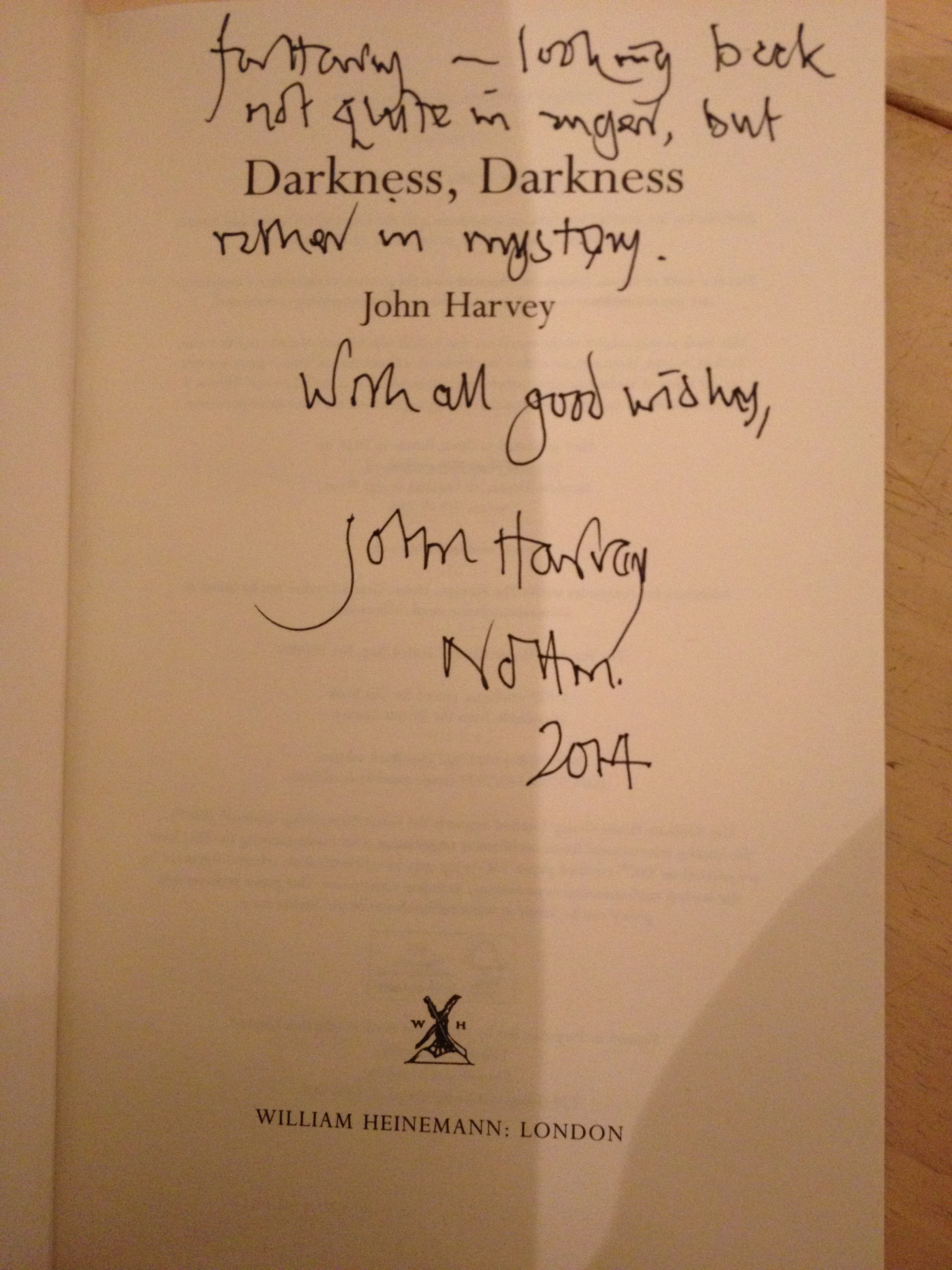
My publisher, Ross Bradshaw, the Managing Editor of Five Leaves Publications (and, more recently, the proprietor of the thoroughly excellent independent and radical Five Leaves Bookshop) has had a long professional relationship with John. When the two did a couple of additional promo events in the County, Ross very kindly had John sign me a shiny 1st edition of Resnick’s last case and his dedication very kindly references my own book; a great honour!

photo 2Of both personal and professional interest to me, the book is set during the miners’ strike, thirty years ago. The research is first-rate and John conveys an authentic and accurate flavour of the times. That said I was amused when Ross observed, “It’s not often I can say that I changed the course of literary history, but after I read a proof copy of John Harvey’s book I emailed him to say he had got a small but important detail of the aftermath of the 1984/85 Miners’ Strike in Nottinghamshire wrong and that he was not as conversant with the history of the local Robin Hood Railway Line as he could have been.

John received the comments on the last day it was possible to make changes, and, rather than responding “nobody likes a smart-arse, especially one who knows about trains”, he was able to get the publisher to make the changes. There we have it then, another novel saved from sin… or at least two small sentences amended that perhaps nobody else would have noticed, but still.”

It falls to me, then, to point out that both John and Ross still managed to miss a couple of things. Firstly, no Notts strikers marched back to work behind a brass band, with the Area firmly under the control of the scabs. And secondly, John cites the Area as having twenty-five pits; it actually had twenty-seven, at the time of the strike, with a further four workshops, making a total of thirty-one NUM Branches.

Neither of which detracts from what is a superb swansong for Charlie Resnick. Nuanced, rich and beautifully evocative, Darkness, Darkness is easily among the finest British crime novels published this year. Highly recommend.